
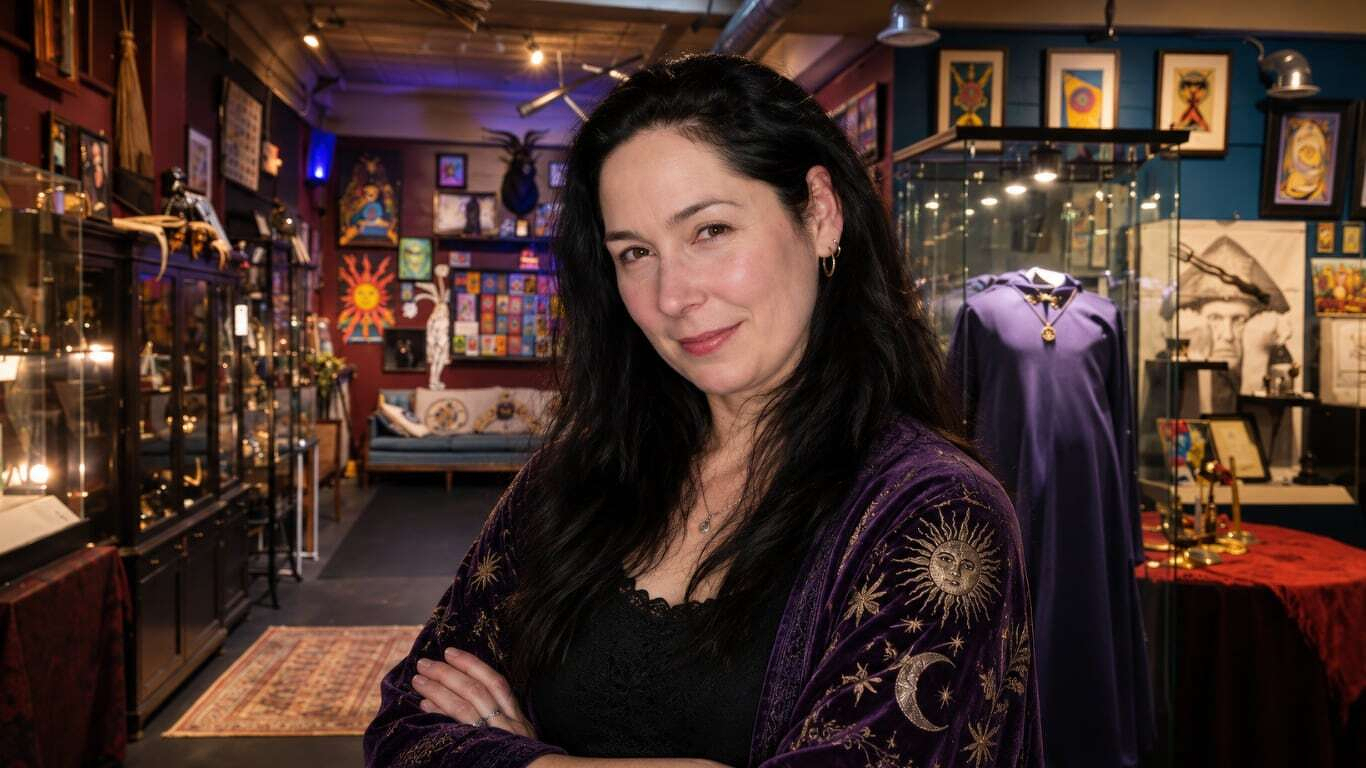
Founded in 1966 by pioneering Wiccan Raymond Buckland, the Buckland Museum of Witchcraft and Magick in Cleveland, Ohio, houses an extraordinary collection of ritual tools, ceremonial objects, and artifacts associated with the history of witchcraft and the occult. But what happens when objects created to perform magic become objects preserved behind glass? We put that question to Toni Rotonda, the museum collection’s owner, Wiccan high priestess, and author of Keeping the Circle: 60 Years of the Buckland Museum of Witchcraft & Magick:
“A ritual object is meant to be used. A museum artifact is meant to be preserved. Do those two purposes ever conflict? Can you preserve the physical object while accidentally killing what made it magical?”
Listen to her answer.
This is Tony Rotonda from the Buckland Museum of Witchcraft and Magic, and you asked a question:
“A ritual object is meant to be used. A museum artifact is meant to be preserved. Do those two purposes ever conflict? Can you preserve the physical object, while accidentally killing what made it magical?”
That is a great question, and it’s something that we have discussed many times in the museum.
It’s really not a black-and-white answer. There are certain things to consider. Ultimately, we believe that the question of whether an artifact should be used or not isn’t just a blanket yes or no. Each object must be considered individually, with respect for its history, its spiritual associations, its condition, and, a lot of times, the traditions- the witchcraft tradition that it may originate.
At the museum, we’ve recognized that a lot of the objects in our collection are more than just simply historical artifacts. While we don’t anthropomorphize these objects, or presume that each one of them, which they don’t, not all of them do. We don’t presume that each one of them possess a consciousness. We acknowledge that many do carry specific spiritual significances and energies associated with their histories or how they were used, so we do believe that many of the objects may retain or carry an energy through its use, whether that use was sacred, intentional, harmful, yes, harmful or abusive.
As a result, we do not believe that every artifact should necessarily be handled or worn. You know, maybe worn the cloaks or the jewelry, or used in ritual. So, not all of them should be used. Some of them should just be left to rest. Some objects deserve really to remain undisturbed, and there are reasons for that.
Others may carry energy that we feel warrant a caution, or people need to be protected from. The Demon in a Box, for example. I don’t know if you’re familiar with that, but the Demon in a Box is an artifact that we believe should be approached with particular care, and its presence in the museum is it serves as educational purposes, but doesn’t necessarily mean that we encourage any kind of interaction with it.
Our primary responsibility is to protect and preserve the museum’s collection. However, we also recognize that that responsibility extends beyond the objects themselves to protect those that may encounter them, so we do keep that into consideration.
At the same time, we do believe that every artifact should be looked at in different ways. Some objects were created, consecrated, or used for a specific ritual purpose, and we feel that their continued use may be appropriate under the right circumstances.
We do believe that some items should be protected, and some artifacts or items should be protected from people.
So, in particular, some artifacts come to us that may have been consecrated in a particular tradition, like a Gardnerian or Alexandrian or any other witchcraft tradition, and for example, a Gardnerian sword or an Alexandrian athame or chalice, it’s not just simply a generic tool that you know was donated that we don’t really have a history of. These objects carry the significance of the practices or the initiations of that particular tradition, and with careful consideration, we believe that some of these items should be used, and they carry on that energy.
However, we also believe that they should only be used by the practitioners that have been initiated into those traditions. I personally don’t use anything, but in some rituals, if we have somebody that may be an Alexandrian or a Gardnerian. We do give them permission to continue to use those instruments to keep the energy going. We do believe that some items should be protected, and some artifacts or items should be protected from people. And then some we believe need to continue their work.
So yes, in a nutshell, it’s not a black-or-white issue. It’s each individual item has their own story and their own use, and some of those, I don’t believe that, per your question, is killing the energy. Some of those just need to rest for different reasons.
It doesn’t mean that the energy is still killed. It is still there. If you’re sensitive to it, you can usually feel it. But that doesn’t necessarily mean they need to be used.