
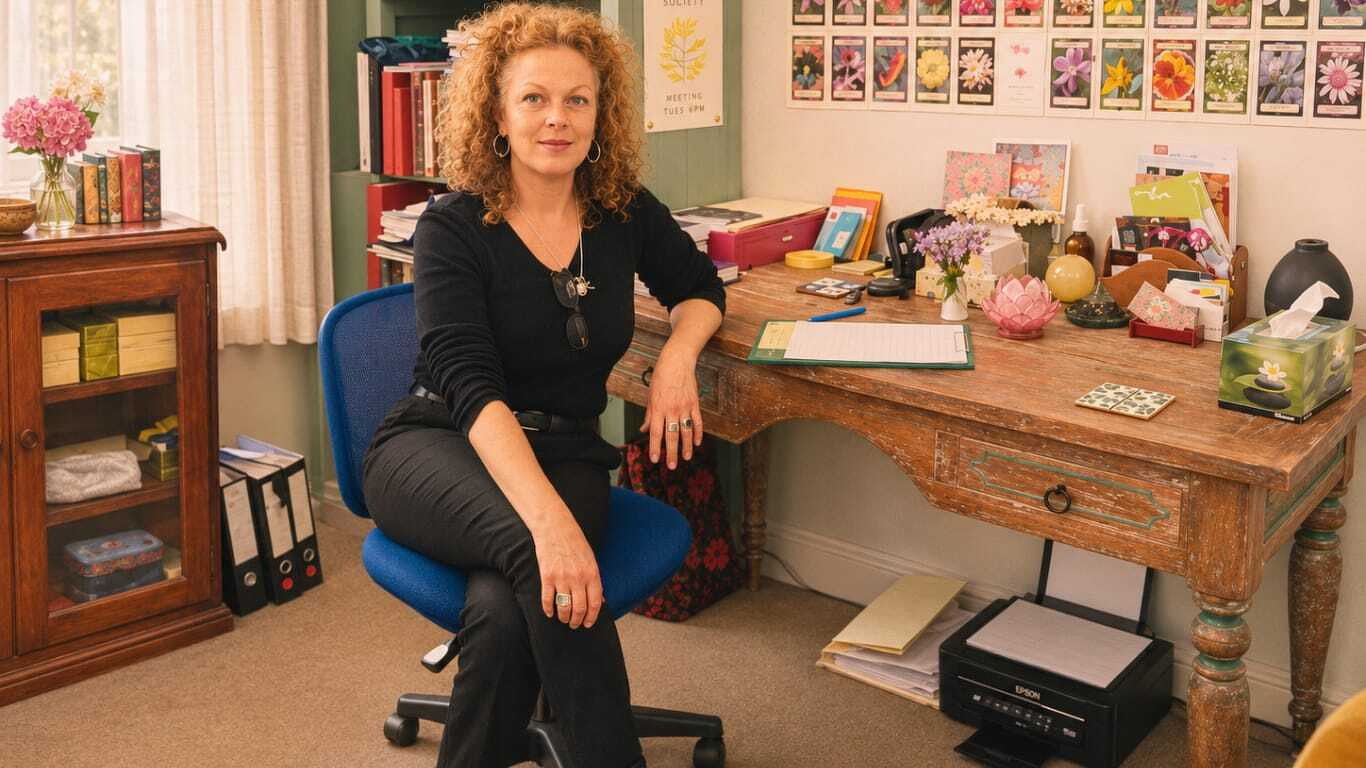
Angela Kirby is an Australian transpersonal art therapist, counsellor, and visionary artist whose work explores the territory where creativity, emotional well-being, and spiritual practice overlap. She’s also the author of Creating Wisdom and Magic in Life and Love. Her practice includes professional clearing, which she describes as a means of removing unseen negative influences.
But here’s a question: if a ritual leaves someone genuinely transformed, does that tell us anything about whether the supernatural was involved? And if we can’t establish what caused the transformation, who gets to decide what actually happened?
So I asked Angela:
“Your practice includes spiritual clearing and creative approaches to emotional well-being. But imagine someone undergoes a ritual intended to remove an unseen negative influence and afterward experiences genuine relief, renewed confidence, and a transformed relationship with the world. Suppose we subsequently discover that no external influence was ever present. Has the ritual failed, or succeeded in a way its practitioners didn’t anticipate? And how might we distinguish a meaningful psychological transformation from evidence that something supernatural actually occurred, without dismissing the person’s experience?”
Angela wasn’t entirely convinced by the premise of my question. Her first objection was a good one.
Listen to her answer.
Yeah, hi. I love the question. The situation basically says that the ritual failed or succeeded in a way its practitioners didn’t anticipate, because they subsequently discovered that there was no external influence that was ever present. A. How do you know that? And then, B, how might we distinguish a meaningful psychological transformation from evidence that something supernatural actually occurred, without diminishing the person’s experience?
Everybody’s experiences in life, for whatever, like you know, having worked as a practitioner for many, many years, doing a particular process, especially in transpersonal art therapy, I’ve noticed the stages that clients go through.
For example, some of them might actually go through stages. So, the situation might be that this particular process, or whatever it might be, might just be done in one session. Over the years, I’ve noticed that some situations can take two or three sessions. Two sessions seemed like extraordinary, and then it became several more.
I think that we’ve really changed. I know that we’ve really changed over the years, including me, the practice of the work that I do, and the terrain that we now find ourselves in.
I don’t know how we can actually prove what’s happened … or even that something supernatural has happened.
So, look, when it comes to, I don’t know how we can actually prove what’s happened, or that’s, or even that something supernatural has happened. Like I’ve been witness to a couple of situations, or one in particular, that seemed so extraordinary that it was, you think, no, that couldn’t have possibly happened, or that it happened, but that it couldn’t possibly be magic, or it was just coincidence, or whatever. So we have to get out of our own way.
I think transformation is something that happens over time. There might be something or other that happens initially, but look, you know, it’s subjective, isn’t it? Because the person’s experience is the person’s experience, and they’re the ones who are the truth-tellers of what’s going on, whether it’s truth they’re telling us or not, but they’re the ones who experience it.
So I can’t experience what somebody else has done. So you know it’s subjective, isn’t it? So the transformation quite often happens over many years, many months, years.
Yeah, that’s, like, a fascinating situation, I would say.
So, yeah, I don’t know. I think we’re putting this in a box, and it needs to be unboxed, as in taken out of the box. I don’t think you can put this in a box, and I think it’s something that I feel is more about whatever arrives in that moment— what arrives, and the analysis is just subjective to what the person, other people believe.